
Skip to content
Tenziva

Tenziva

  • Home
  • English Tests
  • Learn
  • About
Tenziva
Tenziva
  • Illustration of essential A1 English vocabulary categories, including people, home, food, travel, shopping and weather, with a student and learning materials.
    Vocabulary by CEFR Level

    Essential A1 English Vocabulary: 120 Words & Examples

    ByTenziva November 5, 2026November 5, 2026

    Build your essential A1 English vocabulary with 120 useful beginner words and phrases. Learn everyday topics through simple examples, short conversations, and practice exercises with answers.

    Read More Essential A1 English Vocabulary: 120 Words & ExamplesContinue

  • Common English tense mistakes illustrated with incorrect and corrected example sentences, grammar explanations, and a student reviewing English tenses.
    English Tenses

    Common English Tense Mistakes: How to Fix Them

    ByTenziva November 4, 2026November 4, 2026

    Learn how to identify and correct common English tense mistakes. Understand present, past, perfect, and future tense errors with clear examples, explanations, and practice exercises.

    Read More Common English Tense Mistakes: How to Fix ThemContinue

  • Visual comparison of Much, Many and A Lot Of in English grammar, showing countable and uncountable nouns with examples of water, sugar, apples, books and chairs.
    Parts of Speech

    Much vs Many vs A Lot Of: Rules & Examples

    ByTenziva November 3, 2026November 3, 2026

    Learn the difference between much, many and a lot of in English. Explore countable and uncountable nouns, question forms, common mistakes, and exercises with answers.

    Read More Much vs Many vs A Lot Of: Rules & ExamplesContinue

  • Illustration of five English question types: Yes/No questions, Wh-questions, subject questions, question tags, and indirect questions, with example sentences.
    Sentence Structure

    How to Form Questions in English: Rules & Examples

    ByTenziva November 2, 2026November 2, 2026

    Learn how to form questions in English with clear word order rules, do, does, did, question words, modal verbs, and polite questions. Practice with examples and answers.

    Read More How to Form Questions in English: Rules & ExamplesContinue

  • Visual comparison of Zero, First, Second and Third Conditionals in English grammar, featuring example sentences and illustrations of real, possible and hypothetical situations.
    Sentence Structure

    Zero, First, Second & Third Conditionals Explained

    ByTenziva November 1, 2026November 1, 2026

    Understand zero, first, second and third conditionals in English. Compare their rules and meanings, explore real-life examples, and practice with exercises and answers.

    Read More Zero, First, Second & Third Conditionals ExplainedContinue

  • Side-by-side comparison of B2 upper-intermediate and C1 advanced English levels, showing differences in speaking, reading, writing, listening, vocabulary, fluency, and complexity.
    Understanding English Levels

    B2 vs C1 English: Key Differences & Examples

    ByTenziva October 31, 2026October 31, 2026

    What’s the difference between B2 and C1 English? Compare language skills, grammar, vocabulary, fluency, and real-life examples, and learn how to progress from B2 to C1.

    Read More B2 vs C1 English: Key Differences & ExamplesContinue

  • Side-by-side comparison of Must and Have To in English grammar, featuring illustrated examples of wearing a seatbelt, getting up early, and following rules.
    Modal Verbs

    Must vs Have To: Rules, Differences & Examples

    ByTenziva October 30, 2026October 30, 2026

    Learn the difference between must and have to in English. Understand obligations, prohibitions, past and future forms, with practical examples and exercises.
    Read More Must vs Have To: Rules, Differences & ExamplesContinue

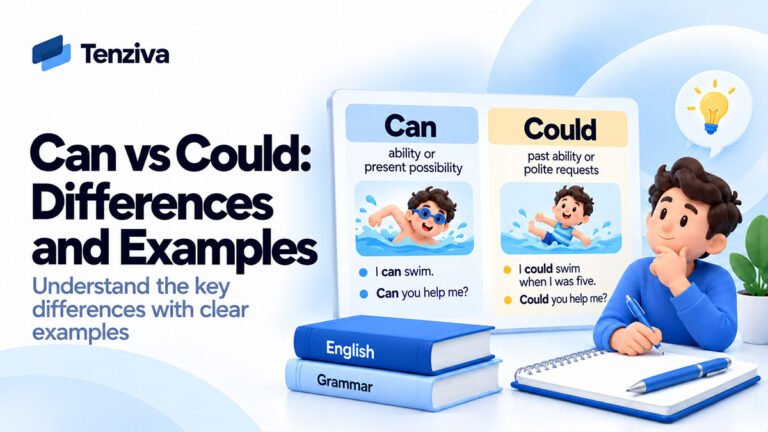
  • Side-by-side comparison of Can and Could in English grammar, featuring swimming illustrations and example sentences about ability and polite requests.
    Modal Verbs

    Can vs Could: Differences, Rules & Examples

    ByTenziva October 29, 2026November 23, 2026

    Learn the difference between can and could in English. Explore rules for ability, polite requests, permission, and possibility, with examples and exercises.
    Read More Can vs Could: Differences, Rules & ExamplesContinue

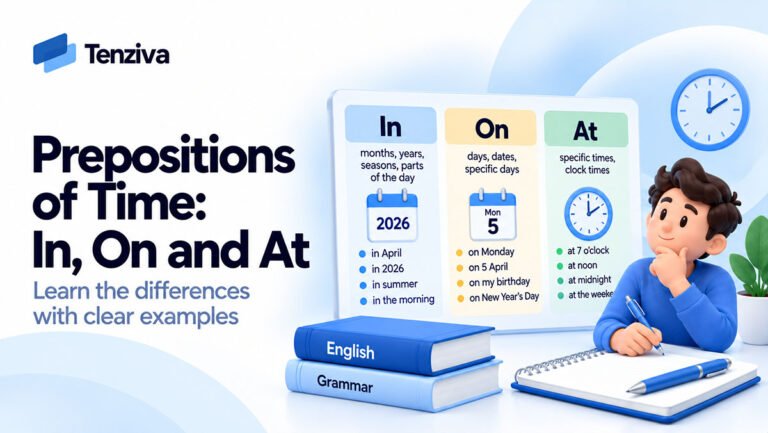
  • Illustration comparing the English prepositions of time in, on and at, with calendar and clock examples showing months, days and specific times.
    Parts of Speech

    Prepositions of Time: In, On and At

    ByTenziva October 28, 2026November 22, 2026

    Learn when to use in, on and at for time in English. Explore simple rules, everyday examples, common mistakes, important exceptions, and exercises with answers.

    Read More Prepositions of Time: In, On and AtContinue

Page navigation

Previous PagePrevious 1 2 3 4 5 Next PageNext

Test your English. Know your level. Improve with practice.

Explore

  • English Tests
  • Learn
  • About

Information

  • Contact
  • Privacy Policy
  • Cookie Policy (EU)
  • Terms of Use

© 2026 Tenziva. All rights reserved.

Manage Consent
To provide the best experiences, we use technologies like cookies to store and/or access device information. Consenting to these technologies will allow us to process data such as browsing behavior or unique IDs on this site. Not consenting or withdrawing consent, may adversely affect certain features and functions.
Functional Always active
The technical storage or access is strictly necessary for the legitimate purpose of enabling the use of a specific service explicitly requested by the subscriber or user, or for the sole purpose of carrying out the transmission of a communication over an electronic communications network.
Preferences
The technical storage or access is necessary for the legitimate purpose of storing preferences that are not requested by the subscriber or user.
Statistics
The technical storage or access that is used exclusively for statistical purposes. The technical storage or access that is used exclusively for anonymous statistical purposes. Without a subpoena, voluntary compliance on the part of your Internet Service Provider, or additional records from a third party, information stored or retrieved for this purpose alone cannot usually be used to identify you.
Marketing
The technical storage or access is required to create user profiles to send advertising, or to track the user on a website or across several websites for similar marketing purposes.
  • Manage options
  • Manage services
  • Manage {vendor_count} vendors
  • Read more about these purposes
View preferences
  • {title}
  • {title}
  • {title}
Scroll to top
  • Home
  • English Tests
  • Learn
  • About